By Lanre Oloyede
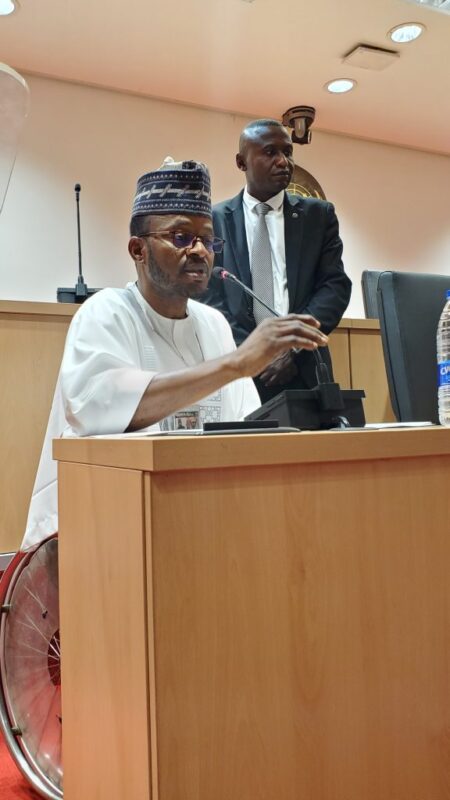
The Senior Special Assistant to the President on Special Needs and Equal Opportunities, Hon. Mohammed Abba Isa, has proposed a range of inclusive measures aimed at curbing crimes and transnational threats against Persons with Disabilities (PWDs) in Nigeria.
Hon. Abba Isa made the recommendations at the 2025 Stakeholders’ Dialogue on Crime Prevention and Transnational Threats, organized by the United Nations Office on Drugs and Crime (UNODC).

According to the Presidential aide, there is a critical need to strengthen civic participation, particularly by promoting a culture of whistle-blowing. He stressed that communities must be encouraged to speak up when suspicious activities are observed, while whistle-blowers must be adequately protected and supported.
“Silence enables organized crime; collective vigilance defeats it,” he said.
Invoking the global disability principle of “Nothing About Us Without Us,” Hon. Abba Isa strongly advocated the full involvement of Organizations of Persons with Disabilities (OPDs), civil society organizations, the Office of the SSA to the President on Special Needs and Equal Opportunities, and other relevant stakeholders in the disability community in the drafting and implementation of Nigeria’s proposed National Strategy Against Organized Crime.

“Policies are most effective when they are shaped by those who live the realities,” he noted.
He further emphasized the urgent need to strengthen Nigeria’s justice system, stating that without justice, accountability, and the rule of law, criminal networks would continue to thrive. He called for effective laws, inclusive policies, and strategic frameworks that prevent and combat organized crime without further marginalizing vulnerable populations through institutional barriers.

Hon. Abba Isa also recommended that UNODC toolkits be made fully accessible to Persons with Disabilities by producing them in braille, audio formats, sign-language interpretation, and easy-to-read versions.
“Accessibility is a fundamental right, not a privilege,” he stressed.
The Presidential aide maintained that close collaboration with agencies such as NAPTIP, NDLEA, the Nigeria Police Force, the Department of State Services (DSS), the Nigeria Security and Civil Defence Corps, and the Ministry of Justice would significantly improve efforts to track, deter, and curb crimes against PWDs. However, he acknowledged that security agencies cannot work in isolation.

Commending UNODC for convening the dialogue, Hon. Abba Isa described the engagement as timely and strategic, noting that it brought together experts, institutions, and community actors to address persistent knowledge gaps on the impact of organized crime on Persons with Disabilities.
He observed that the dialogue aligns with the 2025 International Day of Persons with Disabilities, themed “Fostering Disability-Inclusive Societies for Advancing Social Progress,” adding that genuine social progress is impossible without deliberate efforts to protect the most vulnerable and ensure that no one is left behind.

The SSA emphasized that Persons with Disabilities are disproportionately affected by organized crime, due to existing barriers such as social exclusion, unemployment, and limited economic opportunities, which make them more vulnerable to exploitation by criminal networks.

He noted that women, girls, and children with disabilities are often the worst-affected victims of organized crime and transnational threats, exposing them to exploitation, manipulation, and violence.

“As the SSA to the President on Special Needs and Equal Opportunities, my office regularly receives reports of sexual harassment, rape, robbery, forced labour, and human trafficking involving PWDs across the country,” he disclosed, underscoring the urgency of strengthening prevention, protection, and prosecution mechanisms.

Highlighting real-life cases, Hon. Abba Isa cited instances where blind women were sexually assaulted due to their inability to identify perpetrators; deaf girls trafficked across state borders because they could not communicate distress; persons with intellectual disabilities used for forced labour, street begging, and drug couriering; and wheelchair users attacked because criminals perceived them as easy targets.

“These are not isolated cases,” he said. “They reflect a broader pattern that has become a serious concern to the Government of the Federal Republic of Nigeria.”
He concluded by noting that under the leadership of President Bola Ahmed Tinubu, the Federal Government has taken decisive steps to tackle organized crime, including strengthening enforcement agencies, expanding intelligence-sharing frameworks, improving border security, scaling up national awareness campaigns, and enhancing legal frameworks under the National Action Plan on Human Trafficking and the ongoing development of the National Strategy Against Organized Crime.

