
By Lanre Oloyede
The Senior Special Assistant to the President on Special Needs and Equal Opportunities, Hon. Mohammed Abba Isa, FIPMA, has called for the nationwide replication of the Inclusive Family Planning Project (IFPLAN), describing it as a proven model for advancing equitable access to reproductive health services for women and girls with disabilities.
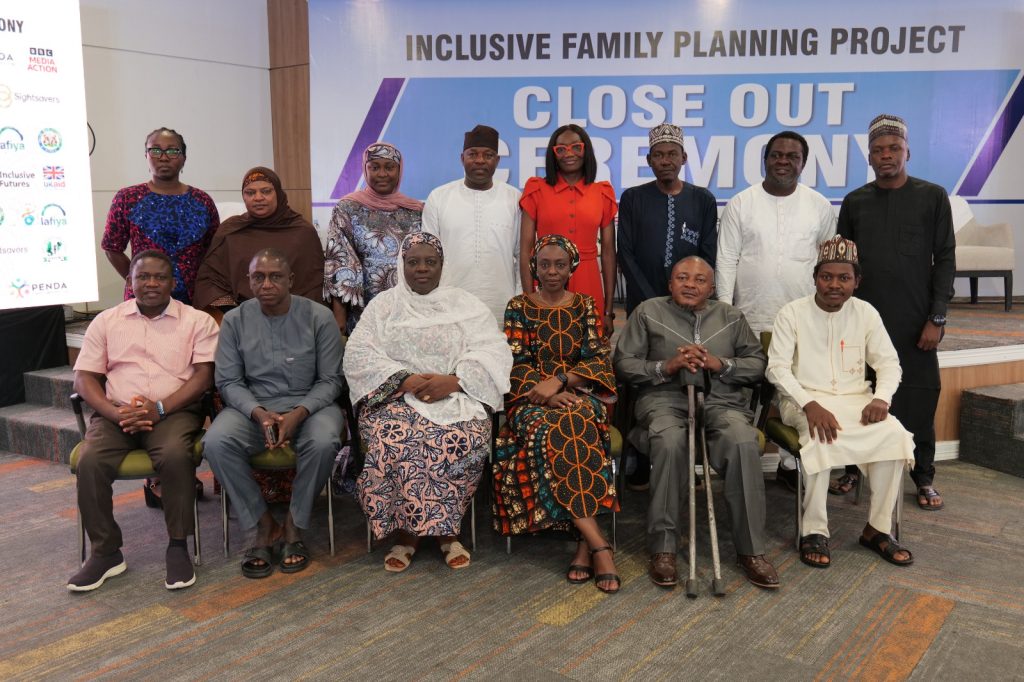
Hon. Abba Isa made this call at the Close-Out Ceremony of the Inclusive Family Planning Project (IFPLAN), organised by Sightsavers Nigeria in partnership with BBC Media Action and the Planned Parenthood Federation of Nigeria (PENDA), with funding support from the Foreign, Commonwealth and Development Office (FCDO).

Represented by his Director Media and Communications Mr Lanre Oloyede, the Senior presidential aide noted that for four years, the IFPLAN project—implemented under the Inclusive Futures umbrella—has operated across selected Local Government Areas in Kaduna State, successfully removing barriers to access, strengthening service delivery, and empowering women and girls with disabilities to make informed decisions about their sexual and reproductive health.
According to him, the project has significantly improved access to family planning services for over 1,000 women and girls with disabilities in Kaduna State, marking a major milestone in inclusive healthcare delivery.
“As we celebrate these achievements, it is important to recognise that the job is far from finished. While Kaduna State has benefitted tremendously from this intervention, many other states—particularly in the northern part of the country—continue to face high fertility rates, low contraceptive uptake, and a high level of unmet need for family planning services,” the Presidential aide said.

He stressed the urgent need to replicate the IFPLAN model across the federation, especially in northern states where the demand for inclusive family planning services remains critical.
Hon. Abba Isa emphasized that the success of IFPLAN has clearly demonstrated that intentionally including persons with disabilities in family planning programmes leads to more effective, sustainable, and equitable outcomes. He therefore underscored the importance of placing sustainability at the core of future interventions.

The project, he noted, directly contributes to the achievement of Sustainable Development Goal (SDG) 3 on good health and well-being, and SDG 5 on gender equality, particularly in relation to access to sexual and reproductive health services. He added that IFPLAN aligns fully with the Renewed Hope Agenda of President Bola Ahmed Tinubu, GCFR, which prioritises inclusive healthcare delivery and the well-being of all Nigerians, including persons with disabilities.
“IFPLAN has shown that inclusive family planning is not only possible, but highly effective. When women and girls with disabilities are empowered with information, access, and support, the benefits extend beyond individuals to entire communities,” he said.

However, the Senior Presidential aide expressed concern that despite the scale and duration of the project, the Office of the Senior Special Assistant to the President on Special Needs and Equal Opportunities was not involved from inception.
“A project of this magnitude, which ran for four years and directly targeted the disability community, unfortunately did not involve my office. This is a significant omission. As the highest government office mandated to champion disability inclusion nationwide, our involvement would have further strengthened outreach, enhanced community mobilisation, and improved the overall impact of the project,” he stated.

He highlighted his office’s direct linkage to all 774 Local Government Areas and access to a comprehensive database of persons with disabilities at community and grassroots levels as critical assets that could enhance the effectiveness of such interventions.
Hon. Abba Isa therefore urged the Country Director of Sightsavers Nigeria to ensure that, going forward, the Office of the President—through his office—is directly involved in all disability-related projects implemented by the organisation in Nigeria. According to him, such collaboration would ensure better coordination, wider coverage, and long-term sustainability.
Commending the organisers, he praised Sightsavers, BBC Media Action, and PENDA for their collaboration on what he described as an innovative and impactful initiative that has transformed the lives of thousands of women and girls with disabilities.
He also paid special tribute to the Project Steering Committee for its dedication and commitment over the past four years, noting that their work has provided a strong and replicable model for inclusive healthcare interventions in Nigeria.
In her opening remarks, the Country Director of Sightsavers Nigeria, Professor Joy Shu’aubu, underscored the transformative power of investing in women, stating that “when you educate a woman, you educate the nation, and when you grant access to healthcare for a woman, you grant access to healthcare for the nation.”
She lamented that sexual and reproductive health issues affecting women with disabilities are often neglected and not treated as a priority, a gap which informed Sightsavers’ decision—alongside its partners—to deliberately focus on this critical area.
Professor Shu’aubu commended the project partners and members of the Steering Committee for their commitment and collaboration, noting that the project specifically trained healthcare personnel in Kaduna State to deliver targeted and disability-inclusive healthcare services.
While emphasizing that it remains the primary responsibility of government to provide quality healthcare to its citizens, she acknowledged the challenge of limited resources amidst growing population needs. In this regard, she expressed profound appreciation to the UK Foreign, Commonwealth and Development Office (FCDO) for providing the resources that enabled Sightsavers and its partners to successfully implement the project.

Delivering a goodwill message, the National President of the Joint National Association of Persons with Disabilities (JONAPWD), Mr. Abdullahi Aliyu, stated that prior to the implementation of the project, many women with disabilities in Kaduna State had little or no access to family planning services.
He noted that the programme has made a significant and measurable difference, stressing that beyond family planning and sexual reproductive health, the initiative has effectively brought women with disabilities under the broader umbrella of inclusive healthcare.
Also speaking at the event, the Executive Secretary of the National Commission for Persons with Disabilities (NCPWD), represented by Dr. Aisha Yahaya Ali, Head of Health and Rehabilitation, commended Sightsavers and its partners for the innovative nature of the project.
She described the initiative as clear evidence that when inclusion is intentional, the impact is meaningful and lasting.
She reaffirmed the Commission’s commitment to sustaining the gains recorded and to strengthening inclusive health services across the Federation.
In her keynote address, the Kaduna State Commissioner for Health, Dr. Umma K. Ahmed, expressed profound gratitude on behalf of the Kaduna State Government to Sightsavers and its partners for their tireless efforts in bringing the Inclusive Family Planning (IFPLAN) project to fruition.
She noted that over the past four years, the project has brought hope and tangible progress to countless families by ensuring equitable access to family planning services for persons with disabilities.
According to her, the initiative has not only improved public health outcomes but has also reinforced the core values of inclusion, dignity, and human rights, with its impact clearly reflected in the improved quality of healthcare delivery across Kaduna State.
Dr. Ahmed further highlighted the unwavering commitment of the Governor of Kaduna State, Distinguished Senator Uba Sani, to inclusive governance. She noted that this commitment is evident in increased budgetary allocations to the health sector and the State’s sustained compliance with the 15 percent Abuja Declaration on health budgeting.
She concluded by assuring stakeholders that the project is not ending in Kaduna State, revealing that there is a specific budgetary provision for the continuation of the initiative in the 2026 budget, thereby guaranteeing sustainability and long-term impact.
