By Lanre Oloyede
The Senior Special Assistant to the President on Special Needs and Equal Opportunities, Hon. Mohammed Abba Isa, has urged donors, development partners, and grant-making organizations to extend financial support to emerging grassroots Organizations of Persons with Disabilities (OPDs) and Non-Governmental Organizations (NGOs), especially those operating in rural communities.
The Senior presidential aide emphasized that these community-based organizations are the heartbeat of the disability movement, noting that “they are closest to the people, understand the daily realities of rural persons with disabilities, and possess the drive to inspire real change when empowered.”

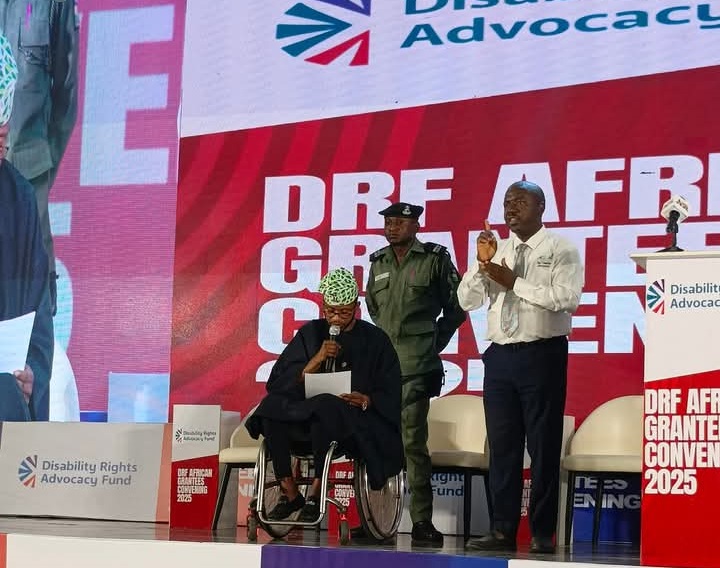
Hon. Abba Isa made this call Monday in Abuja during the opening ceremony of the 2025 Disability Rights Fund (DRF) Grantees Convening, organized by the Joint National Association of Persons with Disabilities (JONAPWD) with funding support from the Disability Rights Fund (DRF).
Held under the theme “Peer and Collective Learning for Africa,” the 4-day event assembled more than 20 prominent Organizations of Persons with Disabilities (OPDs) from across the continent, with delegates drawn from Kenya, Malawi, Mozambique, Rwanda, Togo, Uganda, Canada, and host Nigeria.

The event provided a dynamic platform for OPD leaders, disability rights advocates, and development partners to reaffirm their collective commitment to enhancing regional cooperation and deepening disability inclusion through initiatives supported by the Disability Rights Fund (DRF).

Commending the DRF for its steadfast commitment, Hon. Abba Isa described the Fund’s contribution as “a lifeline to the global struggle for equality, dignity, and inclusion.”
According to him, DRF’s financial and technical support over the years has empowered countless organizations in Nigeria and across Africa to champion the rights of persons with disabilities and promote their full participation in society. “These investments have amplified advocacy voices, inspired inclusive policies, and accelerated the realization of the rights guaranteed in our National Disability Act (2018) and the UN Convention on the Rights of Persons with Disabilities (UNCRPD),” he said.

The Presidential aide outlined key priorities for advancing disability rights in alignment with President Bola Ahmed Tinubu’s Renewed Hope Agenda, which seeks to ensure that no one is left behind. The priorities include:
- Strengthening collaboration between OPDs and government institutions to mainstream disability inclusion across development programs.
- Supporting state and local governments to domesticate and implement the National Disability Act.
- Building capacity for data-driven advocacy to influence inclusive budgeting and policy decisions.
- Promoting leadership development among young persons with disabilities, especially women and girls.

Hon. Abba Isa further encouraged the DRF to consider new approaches for deepening its impact, such as:
- Establishing innovation funds to support emerging disability-focused initiatives.
- Backing joint advocacy platforms between OPDs and government for policy monitoring.
- Investing in digital inclusion and access to assistive technology.
- Facilitating South-to-South knowledge exchange among African OPDs.
Reaffirming the Tinubu administration’s unwavering commitment, he said: “Together with partners like DRF and JONAPWD, we can build a Nigeria where no one is left behind—where every person with a disability can live, learn, and lead with dignity and pride.”

In his opening remark, DRF’s Africa Regional Manager, Washington Opiyo Sati, described the event as an opportunity for “networking, learning, and strategic collaboration.”
“OPDs must understand global and African human rights frameworks, laws, and policies,” Sati said. “Governments must also play their part by ensuring inclusive budgeting—because accountability begins with how much is allocated to education, health, and social protection for persons with disabilities.”

Also speaking, DRF’s West Africa Programme Manager, Barr. Theophilus Odaudu, emphasized the importance of collaboration among OPDs, stressing that when OPDs work together, advocacy becomes more coherent, efficient, and powerful.
Odaudu noted that the convening, which began as a national event for Nigerian OPDs, has evolved into a continental platform for peer learning.
“This expansion is not just about numbers. “It represents a qualitative shift in how we approach disability rights advocacy—recognizing that unity amplifies our voice and strengthens our collective impact,” he stated.

Odaudu outlined the convening’s objectives, which include improving coordination among OPDs, developing a unified advocacy agenda, and exploring how DRF can expand programmatic support across Africa. He also called for greater government commitment to implementing disability-related laws and global commitments.
“Our Disability Act has yet to be fully reflected in most national policies. We must raise more awareness and ensure that ministries, departments, and agencies understand their roles in implementing the Act,” he stressed.

Representing JONAPWD’s National President, Aliyu Abdullahi Adamu, Mr. Stanley Onyebuchi, National President of the Nigerian Association of the Blind (NAB), applauded DRF’s consistent support to OPDs.
“We are excited that DRF continues to support OPDs in raising awareness about disability rights, even at the grassroots.

“This gathering of OPDs from across Africa creates space for sharing ideas and strengthening advocacy. However, inadequate funding remains a major barrier. Without resources, OPDs cannot take the message of inclusion to the communities where it is most needed,” he stated.
Other organizations represented at the Convening included Inclusive Friends Association (IFA), TAF Africa, Hope Inspired Foundation for Women and Youth with Disabilities, Women’s Health and Equal Rights Initiative, Deaf Women Aloud Initiative, Hope Alive for Possibilities Initiative, and the Association of Lawyers with Disabilities in Nigeria (ALDIN).

