By Lanre Oloyede
The federal government has vowed that individuals and organisations that violate the rights of wheelchair users in Nigeria will face sanctions and possible prosecution.
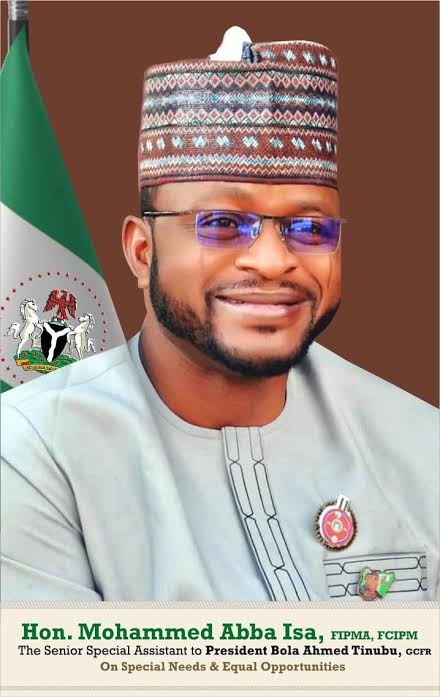
Senior Special Assistant to President Bola Ahmed Tinubu on Special Needs and Equal Opportunities, Hon. Mohammed Abba Isa, gave the warning during a press conference to commemorate the International Wheelchair Day, marked annually on March 1, with the theme “Celebrating Mobility, Independence and Inclusive Infrastructure.”
He said his office would work closely with relevant authorities to ensure strict enforcement of the Discrimination Against Persons with Disabilities (Prohibition) Act 2018, particularly in cases where wheelchair users are denied access to public transport or public facilities.
Represented by his Director Media and Communications, Mr Lanre Oloyede, the SSA noted that the day serves as an opportunity to celebrate the resilience, achievements, and strength of wheelchair users, while also drawing attention to the urgent need for inclusive infrastructure and accessibility across communities.

“Wheelchairs are instruments of independence that enable persons with disabilities to access education, employment, and social activities. However, the challenges faced by wheelchair users in Nigeria remain enormous,” he said.
The presidential aide further noted that the high cost of procuring quality wheelchairs, difficulty in repairs and maintenance, poor road networks, and the absence of ramps and accessible buildings continue to hinder the mobility and independence of many users.
He expressed concern over discriminatory practices by some transport operators who refuse to convey wheelchair users or demand extra charges.
“It is unacceptable that in 2026, a wheelchair user is still subjected to humiliation, denied boarding, or charged extra simply because they use a wheelchair. A wheelchair is not luggage or a load—it is part of a person’s mobility and identity. There is absolutely no basis for discrimination,” he said.
Abba Isa further called on transport unions, building developers, government institutions, and private sector operators to prioritise inclusive infrastructure in their operations.
“Ramps must become standard. Elevators must be functional. Sidewalks must be accessible, and public transportation must be inclusive. Inclusive infrastructure is not charity; it is a constitutional and moral obligation,” he added.
He also disclosed that the administration of President Bola Ahmed Tinubu, under the Renewed Hope Agenda, is taking steps to encourage the local manufacturing of wheelchairs in Nigeria to reduce costs, improve maintenance, and create employment opportunities for persons with disabilities.
“Local production will reduce the cost of procurement, ensure easier access to spare parts and repairs, and create sustainable employment opportunities for persons with disabilities. Local production means local empowerment and economic inclusion,” he said.
In her remarks, the Vice President of the National Association of Persons with Physical Disabilities (NAPWPD), Amb. Mube Awala Beatrice, said the association was using the occasion to raise awareness about the millions of persons with physical disabilities who still lack access to appropriate wheelchairs.
She called for collective action to remove barriers that hinder the full participation of persons with disabilities in society.
Beatrice noted that Nigeria has taken important steps towards disability inclusion, including signing the United Nations Convention on the Rights of Persons with Disabilities in 2007 and enacting the Discrimination Against Persons with Disabilities Act in 2018.
She also highlighted initiatives such as the National Roadmap for Local Production of Standard Assistive Technologies and the establishment of the National Commission for Persons with Disabilities (NCPWD) to oversee accessibility and inclusion efforts.
The NCPWD, she said, has developed accessibility standards for public facilities including ramps, Braille signage, and accessible toilets, while also promoting assistive technology programmes aimed at encouraging the local production of wheelchairs and prosthetic devices.
Despite these efforts, she observed that challenges such as inadequate implementation of policies, limited funding, and low public awareness still persist.
“As we mark this day, we join the voices of over 35 million Nigerians with disabilities to call on federal, state and local governments to strengthen the implementation of the Discrimination Against Persons with Disabilities Act and other policies that promote improved living conditions for persons with disabilities,” she said.
Also speaking, Chairman of the NAPWPD FCT Chapter, Mr. Agbo Christian Obiora, described a wheelchair as a symbol of independence, dignity and opportunity.
“A wheelchair represents the ability to attend school, go to work, vote, run a business, raise a family and contribute to national development,” he said.
Obiora, however, lamented that many wheelchair users still encounter barriers such as inaccessible buildings, lack of elevators, polling units located in upper floors, and transportation systems that exclude persons with disabilities.
He called for urgent measures including affordable and high-quality wheelchairs through government-supported programmes, full enforcement of accessibility laws, inclusive transportation systems, and mandatory accessibility compliance in all public and private buildings.
In his contribution, founder and Executive Director of the Association of Accessibility Professionals, Barr. Yusuf Iyodo, said accessibility must move beyond policy statements to practical implementation.
“A wheelchair is not a symbol of limitation; it is a tool of mobility and independence. What truly limits people are inaccessible buildings, poorly designed infrastructure, and systems that fail to consider everyone,” he said.
Iyodo stressed that accessibility is a fundamental right and urged policymakers, developers and institutions to ensure that infrastructure, transport systems and public facilities are designed to accommodate everyone.
“On this International Wheelchair Day, we call for stronger enforcement of accessibility standards and deliberate action to ensure that inclusion becomes a reality in Nigeria,” he added.
